
Charles County Arrest Warrants Explained
An arrest warrant is a written command from a judicial officer telling a peace officer to take a named person into custody. In Maryland it follows a charging document and a probable-cause decision. Courts reach for it when an appearance notice is not enough. Charles County cases run through two courts. The District Court of Maryland for Charles County handles traffic, misdemeanors, certain felonies, and ordinance matters, and its commissioners issue arrest warrants after reviewing a sworn application. The Circuit Court for Charles County handles felony trials and other circuit matters, where a judge or a clerk acting under rule issues process. Courts and Judicial Proceedings §2-107 sets the Circuit Court form and directs the warrant to the clerk and the serving officer.
Note: an arrest warrant authorizes custody.
Charles County Arrest Warrants and the Commissioner
A District Court commissioner is the judicial officer most people in Charles County meet first. Maryland keeps commissioners on duty at all hours, and their work starts with a sworn statement rather than an indictment.
- A complainant or an officer prepares an Application for Statement of Charges and swears to it in person.
- The commissioner reviews the facts and decides whether probable cause exists.
- The commissioner chooses between a criminal summons and an arrest warrant.
- If a warrant issues, a law enforcement agency receives the document for service.
Commissioner filings cannot be mailed or emailed in Charles County, so the application happens in person. The same office handles the initial appearance and release decision after an arrest.
Inside a Charles County Arrest Warrant
A Charles County arrest warrant carries court identifiers and operational detail. A public case screen shows only a slice of it, and the file on an unserved warrant can be restricted.
| Case Number | The court file the warrant belongs to, and the number the clerk asks for first. |
|---|---|
| Warrant Control Number | A separate identifier shown on the statewide recall order. |
| State v. Caption | The case name the court uses on every filing. |
| Charge or Offense | The pending matter, labeled as felony, misdemeanor, or traffic. |
| Issuing Authority | The commissioner, judge, or clerk who signed the process. |
| Service Agency | The law enforcement office that received the warrant for service. |
| Descriptor Block | Name, date of birth, and physical identifiers used to confirm the right person. |
The descriptor block on a Charles County warrant exists to help an officer identify the correct person. It is not a research tool, and no values from it belong on a public page.
Unserved Charles County Arrest Warrants
Maryland opens judicial records by default, then narrows access in specific situations. The limit that surprises Charles County readers most concerns warrants that were never served.
Key Rules:
General Provisions §4-316 restricts an unserved arrest warrant and its charging document from public release, with narrow exceptions.
Courts and Judicial Proceedings §3-8A-27 keeps juvenile records confidential and outside the public search route.
The practical result: a public case search can stay silent about a warrant that exists. Ask the Charles County clerk about the case. Ask the sheriff about service. A blank screen is not an answer.
Note: a records request is not a workaround for a restricted file, and a request for every warrant tied to a name is not a useful one.
Serving Arrest Warrants in Charles County
Service in Charles County is a sheriff's function with one documented municipal exception, and three offices matter for different reasons.
A patrol station is not a court and not a bond office. District I in La Plata, District II near Indian Head, and District III in Waldorf are service locations in Charles County, not places to file a recall.
Returned Charles County Arrest Warrants
Most commissioner warrants in Charles County are processed and served by the Sheriff's Office. One narrow exception covers process returned to the La Plata Police Department. The town's General Order 316 explains the policy side. Only a police officer or a sheriff may serve criminal process, the officer gives the defendant a copy, and the warrant stays in force until it is served, returned, or recalled. Returned and recalled are not the same word. Ask the clerk which one applies.
Comparing Arrest, Summons, and Bench Warrants
Three documents can arrive from the same Charles County courthouse, and each one asks something different of the person named.
| Point | Arrest Warrant | Criminal Summons | Bench Warrant |
|---|---|---|---|
| What it does | Commands an arrest | Orders an appearance | Commands an arrest |
| Who issues it | Commissioner, judge, or clerk under rule | Commissioner or judge | The judge handling the case |
| Typical trigger | A charging document and probable cause | The same review, with a court date instead | A missed date or court order |
| How it clears | Recall, bond, or arrest | Appearance on the date | Recall, reset, bond, or appearance |
An arrest warrant and a bench warrant both authorize custody, and a summons does not. A bench warrant grows out of a case that is already open. An arrest warrant usually opens one. The bench warrant search page covers the Charles County missed-date route in more detail.
Charles County Arrest Warrants and Custody
An arrest does not end at the roadside in Charles County. The Detention Center handles Central Processing, intake, records, transportation, and court holding, and booking is where the first appearance process begins. The Sheriff's Office detention page describes those functions and the public visiting rules that follow.
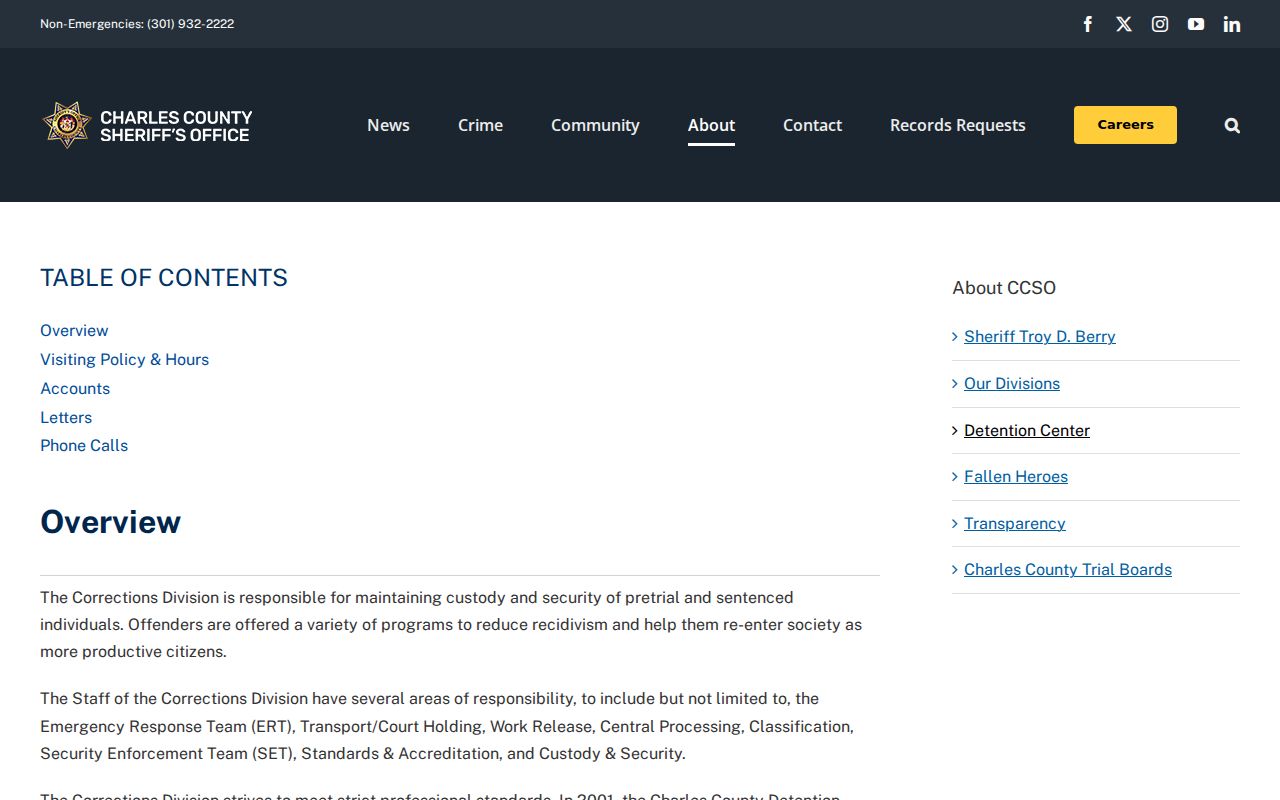
Booking and bail are separate steps in Charles County. A judicial officer sets release conditions, and the lobby does not. The county facility listing gives 301-932-3100 while the sheriff's detention page lists 301-932-3101, so confirm the current number before calling. No county bond schedule is published, and a professional bondsman charges a fee that is generally nonrefundable.
If There's an Arrest Warrant for You
An open Charles County warrant is a custody risk that does not improve with time, and the lawful options run through the issuing court.
- Speak with a Maryland criminal attorney before arranging anything.
- Ask the issuing clerk whether the court allows a motion to recall or a new appearance date.
- Ask about bond: the amount, the accepted form, the location, and the hours.
- If a surrender is planned, ask the Warrant/Fugitive Unit where to report and what happens after booking.
- Keep every order, receipt, and new court date in one place.
Important: an open warrant can be served during a traffic stop or any contact with law enforcement, so plan the next step with counsel rather than waiting.
Federal Arrest Warrants and Charles County
A federal warrant is not a Maryland court record, and no state search will return it. Charles County sits in the Southern Division of the U.S. District Court for the District of Maryland, where federal matters are filed in Greenbelt. The U.S. Attorney's Office for Maryland lists the divisions covering the state. The Southern Division is the one that includes Charles County.
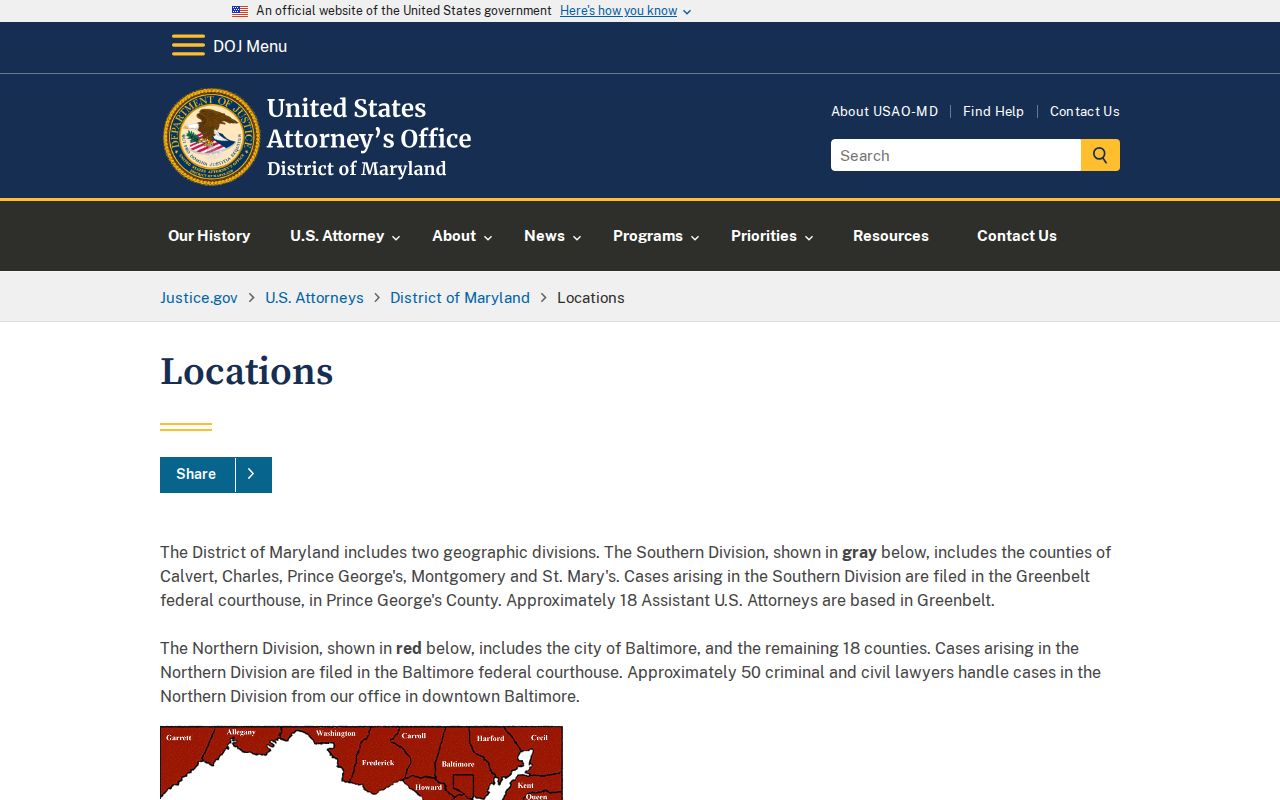
Federal dockets live in the federal case locator rather than in Maryland's state portal, and federal fugitive work in Charles County is handled by the U.S. Marshals Service.
Note: a clean Maryland search says nothing about a federal docket, and a federal index says nothing about a District Court traffic case.
Charles County Warrants and Your Relative
A family member often learns about a Charles County warrant before the person named does. The useful help is routing, because a relative who calls the wrong office loses a day.
- Find out which court set the case and when the last hearing was scheduled.
- Call that court's clerk, and expect to show lawful authority before protected details are shared.
- Ask whether the case sits in District Court or Circuit Court, since the two keep separate files.
- Route the person named to an attorney before any surrender plan is made.
- Leave the confrontation to law enforcement. A relative should not try to serve a court's business.
Charles County also runs an anonymous tip line, built for a different job than a warrant check. The most wanted list page covers how that program works and why it posts no roster.