
Charles County Municipal Court Warrants
Start with a fact that shapes everything else: Charles County has no separate municipal criminal court. Maryland's court directory lists a District Court and a Circuit Court here, and nothing more. A town can pass ordinances and collect civil fines on its own. But a criminal ordinance charge gets heard in District Court. That is why a municipal warrant in practice means process tied to a town ordinance or a town case, not process handed down by a town judge. So ask which court issued the paper before you ask which town wrote the ticket. The answer to that first question decides who can help you, because the issuing court controls the warrant. The town that wrote the ticket cannot recall it or set bond on it, no matter how helpful its office tries to be.
Note: a town name on a citation does not create a town court, and it does not create a town warrant lookup.
The Rule Behind Charles County Municipal Warrants
One statute produces this arrangement. Courts and Judicial Proceedings §4-301(b)(3) gives the District Court exclusive original criminal jurisdiction over nonfelony county and municipal ordinance violations. The state publishes the statute text itself. A reader can confirm the rule straight from that page instead of trusting a summary.
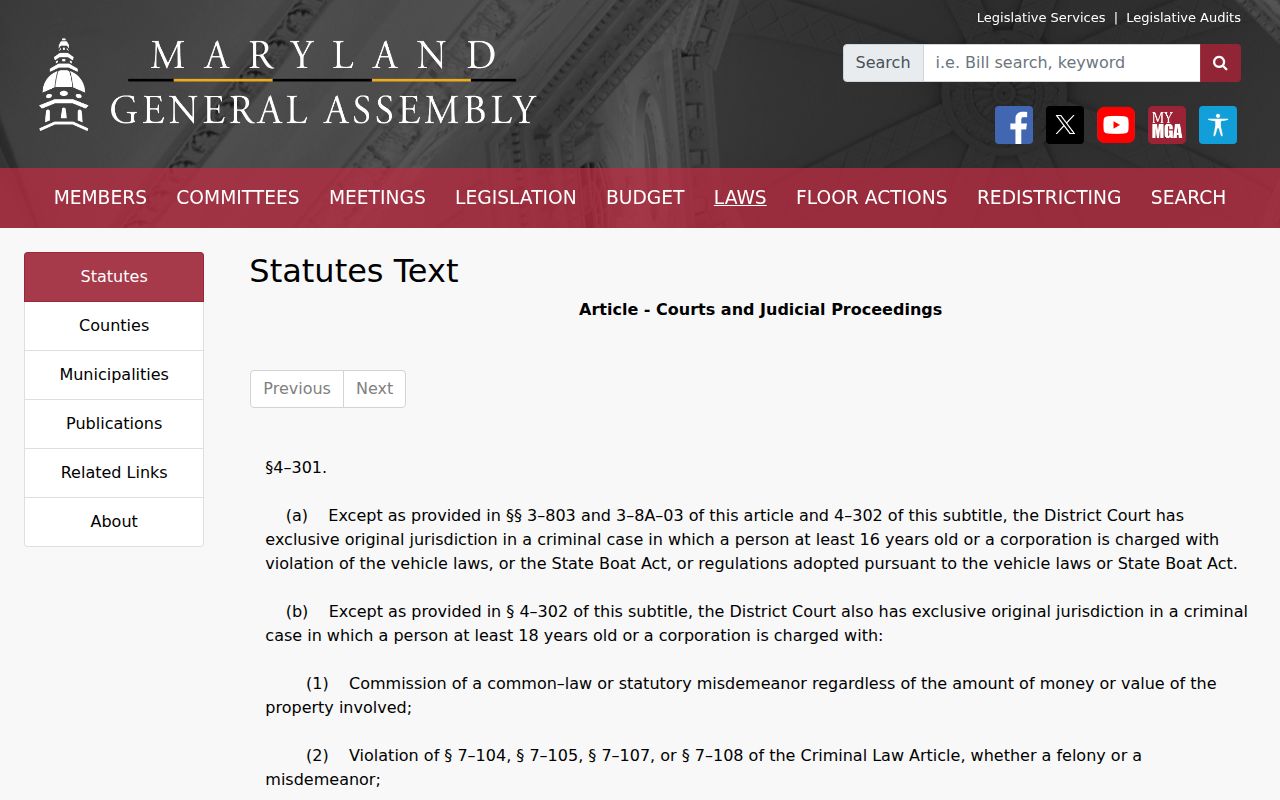
That same rule is why a Charles County city court search comes up empty. No such court exists to search, so the District Court is the place to look.
Charles County Cities With Municipal Courts
Three places in Charles County are incorporated. Each handles police questions differently, and none runs a criminal court of its own.
| Place | Police Arrangement | Court | Contact |
|---|---|---|---|
| La Plata | La Plata Police Department, 101 La Grange Avenue | No municipal criminal court; ordinance and traffic cases go to District Court | 301-934-1500 |
| Indian Head | No town department; non-emergency calls route to CCSO District II | No municipal criminal court | 301-743-2222 |
| Port Tobacco Village | No police department or warrant desk located | No municipal criminal court | 202-321-1844 |
The court answer never changes across the three towns. What changes is who picks up the phone for a police question in Charles County.
Civil Municipal Infractions in Charles County
A municipal infraction is not a criminal warrant case. Local Government §6-102 lets a town enforce an ordinance with a civil penalty. That process runs through the municipality, not through a courtroom warrant in Charles County.
| Point | Civil Municipal Infraction | Criminal Ordinance Charge |
|---|---|---|
| Who enforces it | The town, through its own process | The state, through a prosecutor |
| Where it is heard | Usually no court appearance at all | District Court of Maryland for Charles County |
| What it can produce | A civil penalty and a town record | A summons, an arrest warrant, or a fine |
| How it clears | Payment to the municipality | Court action: payment, appearance, or recall |
The line matters more than it sounds like it would. A civil fine never puts a person in front of a judge, and a criminal charge can. Before assuming anything, ask the town which category the notice falls under.
Checking a Municipal Court Warrant
A town ordinance case moves through the same channels as the rest of the Charles County system. The one extra stop is the town office itself.
- Ask which court issued the paper. For a Charles County ordinance case, that is the District Court.
- Search the case in Maryland Judiciary Case Search with the correct court filter and case type.
- Call the county clerk at 301-934-5037 or the District Court general line at 301-934-5110 and ask whether a warrant is current.
- Call the town to ask whether it holds a municipal record, which is a different question from a court status.
- Call the CCSO Warrant/Fugitive Unit at 301-932-3065 about service, or La Plata Police at 301-934-1500 if the process was returned to the town.
None of these steps involves a city warrant lookup, because no Charles County town publishes one to search.
Charles County Municipal Warrants and Town Police
La Plata is the only incorporated place in Charles County with its own police department. Its published policy, General Order 316, spells out how criminal process gets served in town. Only a police officer or a sheriff may serve it. The officer hands the defendant a copy. And the warrant stays in force until it is served, returned, or recalled by the court. La Plata also publishes a policy and transparency index, which is worth knowing how to read. That index is a set of rules, not a record. Finding it tells you how service works, never whether a warrant actually exists against a person.
Inside a Municipal Court Warrant
A town ordinance case produces a short record. When you read one in Charles County, these are the fields worth hunting for.
| Case Number | The docket number in the District Court file. |
|---|---|
| Issuing Court | The District Court of Maryland for Charles County in nearly every local ordinance case. |
| Ordinance or Charge | The town code section or the state charge the case rests on. |
| Town or Agency | The municipality that wrote the notice, if one did. |
| Status Wording | Served, returned, recalled, satisfied, or paid. Read the exact term. |
| Service Agency | The office that received the process, usually the Sheriff's Office. |
A paid fine and a recalled warrant are two different entries. A town receipt proves payment, and it does not prove that the Charles County court recalled anything.
Indian Head Municipal Warrants and Sheriff Routing
Indian Head keeps no police department of its own. The town routes non-emergency police matters to CCSO District II at 301-743-2222. The town's official page lists those emergency and non-emergency contacts for residents.

That routing never touches the court side of a case. A state ordinance or traffic matter still belongs to the District Court. Town Hall at 4195 Indian Head Highway remains a municipal office. It handles town business for this part of Charles County, and it does not confirm a criminal warrant.
How to Resolve a Municipal Court Warrant
Resolution follows the warrant type, not the town name on the ticket, so the first step in Charles County is always the same.
- Confirm which court controls the case.
- Ask the clerk what the court requires to clear the process.
- If a fine is owed, pay it through the office the court or town instructs, not through a caller.
- Ask whether the town police or the Sheriff's Office holds service.
- Keep the receipt, the order, and the next court date together.
Caution: paying a town fine does not automatically recall a court warrant, and a recall does not erase the underlying case.
A traffic ticket written by a town officer is a separate matter on a separate track. The traffic warrant search page covers where that Charles County case number belongs.
Port Tobacco Village Has No Local Warrant Desk
Port Tobacco Village is the smallest incorporated place in Charles County, with a 2020 Census population of 18 and an incorporation date of 1888. It fields no police department and no municipal criminal court. The mailing address in its State Archives profile identifies the municipality, not a clerk of court. Court questions belong to the La Plata courthouse offices, and county service questions belong to the Charles County sheriff.
Note: do not report to a village address to clear a state warrant. Confirm the issuing court first.
Charles County Municipal Warrant Questions
The fastest way to lose a day is to ask the wrong clerk in Charles County. Each office below keeps a different piece of the warrant picture.
- A town hall answers municipal records, permits, and town code questions.
- A court clerk answers case status, hearings, filings, and whether a warrant is current.
- The Sheriff's Office answers whether county process was received and served.
- La Plata Police answers service questions only when the process was returned to the town department.
- A records request goes to the office that created the record, not to the county in general.
One question belongs to one office in Charles County. A call to the right desk is usually shorter than a call to the wrong one.